Eden
The true story of the Galápagos Affair, as it was labelled by the tabloids, is...
The true story of the Galápagos Affair, as it was labelled by the tabloids, is a fascinating one. Accounts vary, but the facts most seem to agree on are as follows: in the 1930s, a group of Europeans settled on the remote Galápagos island of Floreana, including a family man and his wife, a self-styled Baroness, and a German philosopher with steel teeth. Eventually, the Baroness and one of her lovers went missing. Rumours of murder, blackmail or other foul play quickly spread.

The affair forms the basis of Eden, a film that a title card tells us is “inspired by the accounts of those who survived”. It is perhaps the darkest work yet from Ron Howard, a filmmaker known for his sentimental bent: a film with very few Beautiful Minds and far more Demons than Angels. It is adult in its themes, full of bloodshed and carnage and sex. But it feels like a tone the veteran filmmaker is unfamiliar with, and though it is based on undeniably thrilling real history, in this telling it plays out as implausible and trite.
The context given, early doors, is very pointed. The year is 1929. The Great Depression has left the world economy shattered. “Fascism is spreading,” says the opening title. “People are desperate for a way out.” You can practically see Howard winking down the lens at us, as if to say: “Remind you of anything?” But it’s setting up a satire-for-our-ages which goes ultimately undelivered.
A deeply misanthropic and nihilistic non-parable.
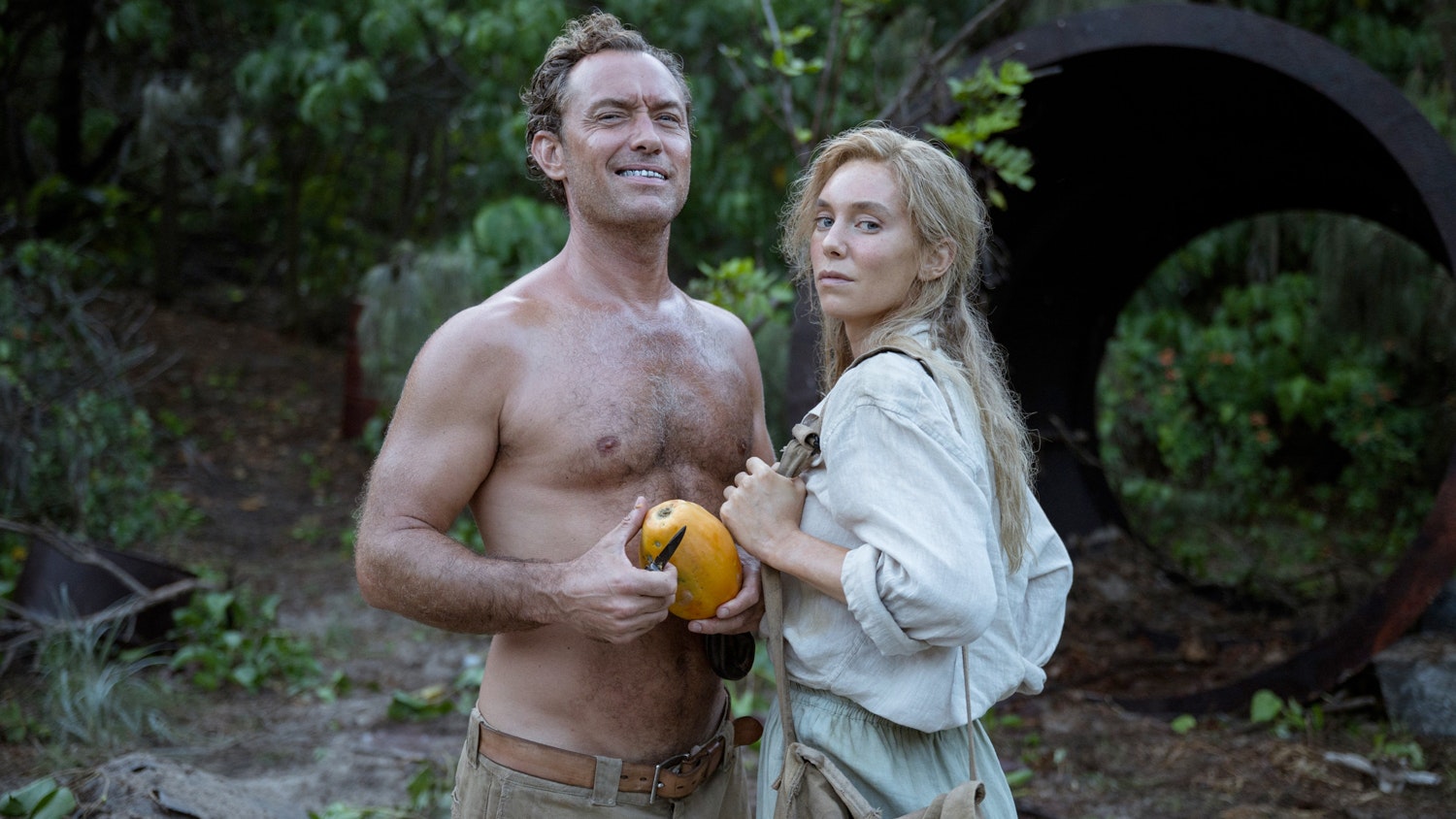
Instead, it’s a deeply misanthropic and nihilistic non-parable, an adult Lord Of The Flies where a bunch of increasingly horrible people struggle to live together in dire conditions. There are the original settlers of the island: the frequently naked philosopher Dr Friedrich Ritter (Jude Law) and his wife Dore Strauch (Vanessa Kirby), who both quote Nietzsche as if in a student dorm and darkly impart dialogue like, “There are many pests... many pests."
Then there are their acolytes: married couple Heinz (Daniel Brühl) and Margret Wittmer (Sydney Sweeney), who are looking to escape Germany’s shattered post-war economy by following in Ritter’s footsteps and eking out a new life on a harsh, remote landscape. And there’s the absurd, Gatsby-esque poseur Baroness Eloise Bosquet de Wagner Wehrhorn (Ana de Armas, adopting a slightly baffling pan-European accent), who uses her sexuality to get everything she wants, which includes a luxury hotel on the island, in direct opposition to the good doctor’s ideals. “I am the embodiment of perfection,” she tells herself in the mirror.
These three camps have competing ideologies but are all trying to escape the real world in some way. But these characters, and the film itself, are so deeply cynical, the conclusions they draw about the world so gracelessly unpleasant, that you almost feel relieved when the bodies finally start piling up. And pile up they do. By the end, almost all the characters seem totally fine with murder, character development that makes almost no consistent sense.
While the real truth may never be known, Howard and screenwriter Noah Pink appear to have chosen the most sensationalist tabloid rumours as fact, printing the legend without giving much thought to what it might all mean for their story — and losing any intrigue or mystery that could have been wrung from its great unknowns. Howard hammers the point home visually, too, with a washed-out palette and ominous cut-away shots of crabs crawling across skeletons. And tensions often feel contrived: one subplot involves the mystery of a missing donkey.
In short, it’s all rather silly. But while this is a fairly straightforward misfire for Howard, you have to admire a veteran filmmaker trying something new and different.
What's Your Reaction?